Fault Injection and DFA on an FPGA AES Core
aes source
I built a differential fault analysis (DFA) collection setup against an AES-128 core on a Lattice iCE40HX8K. It collected eight correct and faulty ciphertext pairs in the shape required by a Piret-Quisquater key recovery. The setup used 4800 on-chip ring oscillators to create voltage sags large enough to violate the AES critical path. I did not run the key recovery, so the deliverable is the validated fault set and its usability criteria.
Hardware setup and threat model
A fault attack pushes a circuit outside its safe operating conditions so that one computation fails in a controlled way. Nothing here breaks AES at the algorithmic level. The attacker instead recovers information from the incorrect result. On this board, the victim's own neighbour in the FPGA fabric generates the disturbance. This matches the threat model for shared and cloud FPGAs, where two tenants are isolated in logic but share one power distribution network. The usual disturbances are clock or supply glitches; this design targets the supply with ring oscillators.
| Target | AES-128, fault at the round-9 input |
|---|---|
| Platform | Lattice iCE40HX8K |
| Fault source | 4800 on-chip ring oscillators |
| Deliverable | correct and faulty ciphertext pairs for DFA |
Ring oscillators as a fault source
A ring oscillator is an inverting gate wired back to its own input, so it never settles. It switches as fast as the silicon allows and draws current on every transition. The design places 4800 oscillators on the die. An 8-bit mask gates the array, with each bit enabling a group of 600.
Enabling the grid creates a sudden current demand on the shared supply,
which causes an IR drop and briefly sags the rail. Gate delay grows as
the supply voltage falls, stretching the AES critical path. If the path
no longer settles within the 60 MHz clock period, a flip-flop captures an
unfinished value and introduces an incorrect byte into the AES state.
The aim is a timing fault in one byte, rather than corruption across a
whole round.
In the lab's top_level.v, the timing variation comes from the
toggle counter cycles_ctr. The cycles_ctr counter does
not reset between encryptions. It freezes while injection is off, then
resumes from its previous value, so the sag lands at a different point in
each encryption. I therefore ran many encryptions and filtered the results
for the required fault shape. The attack is statistical because I could
control the injector settings, but not the exact byte affected in each run.
The useful fault shape
AES-128 runs ten rounds, and round 10 omits MixColumns. A single wrong byte at the input of round 9 stays one byte through SubBytes and ShiftRows. MixColumns then spreads it across all four bytes in one column. Since round 10 has no MixColumns, ShiftRows only permutes those four bytes into fixed ciphertext positions. A usable fault therefore changes exactly four ciphertext bytes on one diagonal. There are four diagonals, one for each round-9 column.
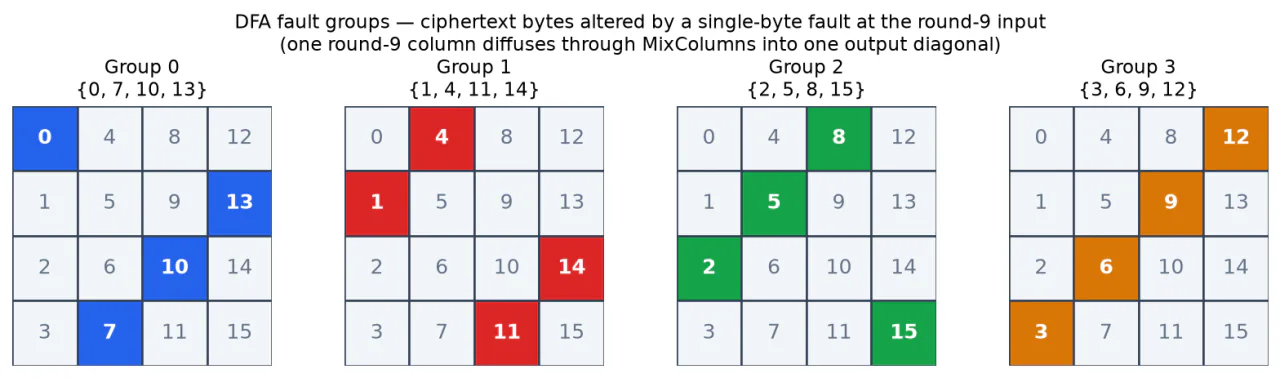
I computed the four groups from the ShiftRows permutation in the AES
core's own shiftrows.v rather than hardcoding byte positions.
This keeps the classifier tied to the implementation's byte ordering:
# ShiftRows forward map (input byte index -> output byte index), from shiftrows.v
_SR = {0: 0, 4: 4, 8: 8, 12: 12,
       5: 1, 9: 5, 13: 9, 1: 13,
       10: 2, 14: 6, 2: 10, 6: 14,
       15: 3, 3: 7, 7: 11, 11: 15}

GROUPS = [tuple(sorted(_SR[4 * c + r] for r in range(4))) for c in range(4)]
# -> [(0,7,10,13), (1,4,11,14), (2,5,8,15), (3,6,9,12)]
_POS_TO_GROUP = {pos: gi for gi, g in enumerate(GROUPS) for pos in g}
For one group, the recovery guesses its four last-round key bytes and undoes the last round on both ciphertexts. It only needs the state where the fault was still one byte wide, since that is where the difference has a shape that can be tested. A correct guess produces a difference that could come from a single-byte MixColumns input, while wrong guesses fail that test. One fault narrows the four bytes to a small candidate set, and a second fault in the same group makes them unique. Two faults for each of the four groups, plus one correct ciphertext, yield the full last-round key. I therefore set the collection target at eight usable faults.
The classifier and its baseline
Not every incorrect ciphertext is useful, so the host software classifies each result against its fault-free ciphertext. It finds the changed bytes and checks which diagonal they occupy. An unchanged result is clean. Exactly four changes on one diagonal are usable. One to three changes on one diagonal are partial, which indicates a round-10 fault. Changes across several diagonals are spread, which indicates a fault before round 9. I discarded partial and spread results because the collection target required the four-byte round-9 pattern.
def classify_fault(correct, faulty):
    """
    "clean"    -- identical ciphertext, no fault
    "usable"   -- exactly 4 bytes differ, all inside one diagonal group
                  (a single-byte round-9 fault; this is what I needed for a DFA)
    "partial"  -- 1..3 bytes differ, all inside one group (a late round 10 fault; the weaker 1-byte-key model, not the standard one)
    "spread"   -- differing bytes span more than one group (fault earlier than round 9, or multiple faults; not usable)
    """
    diff = diff_positions(correct, faulty)
    if not diff:
        return "clean", None

    groups_hit = {_POS_TO_GROUP[i] for i in diff}
    if len(groups_hit) != 1:
        return "spread", None

    group = groups_hit.pop()
    return ("usable" if len(diff) == 4 else "partial"), group
I validated the classifier against a software AES before trusting board output. I first injected single-byte faults at the round-9 input. The classifier marked every result usable and assigned the correct group, with zero misclassifications over 3200 trials. I then injected round-8 faults. It rejected all of them as spread, with zero false positives. Only after those checks did I use it on faulty ciphertexts from the board.
Calibration
The injector has three settings: active oscillator count, toggle period, and active duty cycle. The duty cycle is the fraction of each period for which the grid stays active. The working configuration depends on the physical board, so the calibration tool sweeps these settings. For each configuration, it encrypts a batch of random plaintexts and counts the classifier's verdicts.
The useful region was narrow. Too little energy produced no faults. Too much energy faulted almost every encryption, but the changes spread across several diagonals and became unusable. The single-byte faults appeared in a band where 10 to 40 percent of encryptions failed.
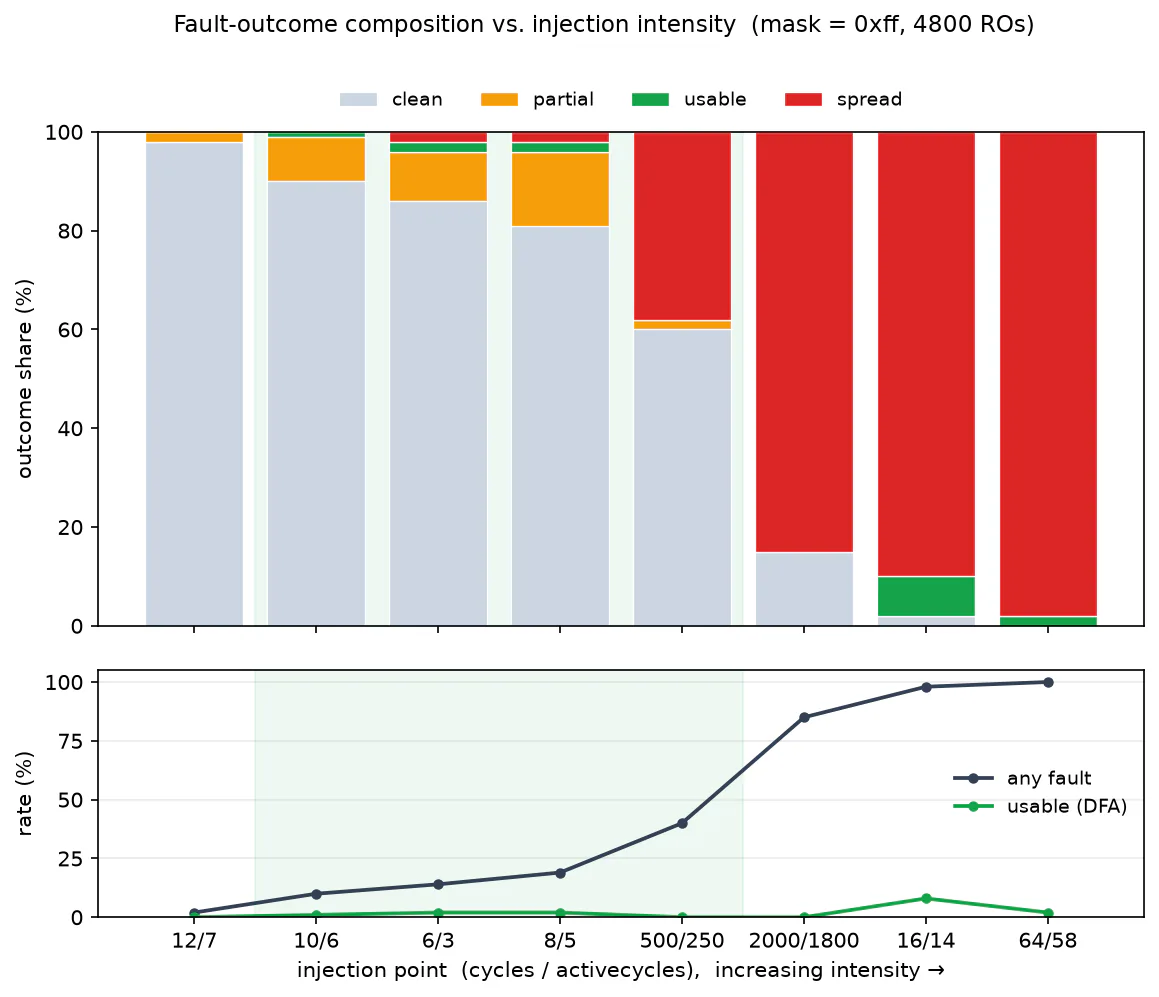
Reducing the active oscillator count below 4800 did not lower the fault rate gradually. On this board, the rate dropped to zero. I settled on the full grid, a short toggle period, and a 60 percent duty cycle.
Board-specific failures
The FIPS-197 known-answer test initially returned a repeating 32-bit garbage word instead of the expected ciphertext. The provided bitstream closed timing at 59.25 MHz, below the 60 MHz target, and my board's silicon was slightly slower. I rebuilt the same source with the correct toolchain and reached 62 MHz. The known-answer test then passed:
Plaintext:  3243f6a8885a308d313198a2e0370734
Ciphertext: 3925841d02dc09fbdc118597196a0b32
I used one strict rule after that failure: the known-answer test had to pass before collection. If the board did not return the FIPS vector, I treated every collected result as untrustworthy.
Newer Yosys versions synthesized each oscillator as two lookup tables
instead of one. At two LUTs per oscillator, the 4800-oscillator design
reached 154 percent utilization and failed place-and-route. The
keep attribute on the feedback wire had pinned an intermediate
net. I rewrote the oscillator as a single NAND gate so the kept net was
the loop node. The oscillator then used one LUT again, and the design fit
at 91 percent utilization:
module ringosc( enable, out );
        input enable;
        output out;
        (* keep *) wire A /* synthesis syn_keep=1 keep=1 */;
        // original: two LUTs per RO on yosys >= 0.6, 154% utilization, P&R fails
        //   assign A = ~A && enable;
        // fixed: one SB_LUT4 (NAND, INIT=0x0FFF) per RO on both toolchains.
        // Only the disabled steady level differs (1 instead of 0), which is
        // irrelevant to the fault attack.
        assign A = ~(A && enable);
        assign out = A;
    endmodule
Fault collection set
The collection script encrypted random plaintexts, kept usable faults, and stopped when every diagonal had two. One run filled all four groups with eight usable faults in 1100 attempts, taking about one minute. Each pair recorded the plaintext, fault-free ciphertext, faulty ciphertext, and altered byte positions.
I verified every collected pair against a software AES. The fault-free ciphertexts matched exactly, and each faulty ciphertext differed in the four positions of its group. Those checks made the set internally consistent with the input required by a Piret-Quisquater key recovery.
The working parameters were mask 0xff, cycles 8, and activecycles 5. With those settings, a collection run filled all four groups in roughly 550 to 1100 attempts, or about one minute of wall-clock time. The script kept only usable faults and stopped once every diagonal had two, while retaining both ciphertexts, the plaintext, and the altered positions.
Finding the board took longer than it should have. The iCE40-HX8K
breakout exposes an FTDI bridge, but on macOS
/dev/cu.Bluetooth-Incoming-Port also matches a
/dev/cu.* prefix and may be selected first. I changed the port
lookup to match the USB vendor id rather than the device name. RTS is
wired to rstin, which is active low, so
setRTS(True) asserts reset. Swapping the two RTS calls holds
the FPGA in reset, and every read times out without an error message:
def reset(self):
    # RTS is wired to rstin (active low): setRTS(True) drives the pin low =
    # reset asserted. Do not swap these or the FPGA stays held in reset.
    self.ser.setRTS(True)
    time.sleep(0.001)
    self.ser.setRTS(False)
    time.sleep(0.001)
    self.ser.reset_input_buffer()
    self.ser.reset_output_buffer()
After the final collection, I repeated the software AES check on every pair. The fault-free ciphertexts still matched exactly, and each faulty ciphertext changed precisely the four positions of its group. I did not run the recovery itself, but the set has the required Piret-Quisquater fault structure.
Limits
The yield of usable faults was low, and I do not have one clean number for it. The collection run gives about 0.7 percent, with eight faults in roughly 1100 attempts. The committed calibration CSV gives 12 percent usable at the same operating point. The sweep used for the figure gives 2 percent usable, while the two reported total fault rates are 28 and 19 percent. These runs happened on separate days, and I did not repeat them enough to decide which value is representative. The yield stayed in the low single digits in collection and varied between sessions more than I expected.
The calibration parameters are specific to this board and need to be measured again on another device. I also did not run the key recovery. The claim that the set is sufficient rests on its validated fault structure, not on a recovered key, so I have kept that limit attached to every recovery claim in this note.
References and implementation
- J. Krautter, D. R. Gnad, M. B. Tahoori, FPGAhammer: Remote Voltage Fault Attacks on Shared FPGAs, suitable for DFA on AES, TCHES 2018.
- G. Piret, JJ. Quisquater, A Differential Fault Attack Technique against SPN Structures, with Application to the AES and Khazad, CHES 2003.
- E. Biham, A. Shamir, Differential Fault Analysis of Secret Key Cryptosystems, CRYPTO 1997.
- NIST, FIPS PUB 197: Advanced Encryption Standard (AES).
- FPGA control software, fault classifier, and calibration tooling